
By Samuel Cove
In one of my more recent early morning doomscrolling fiascos, I came across a Tik Tok with a caption that deeply resonated with me. The video had plain white text over a woman about my age rapping along to Earl Sweatshirt’s Grief, reading: “Live Laugh Love only hits if you survived Grief.” While I think Earl’s blossoming new work could undoubtedly “hit” for any listener, the fifteen second video quickly put something in perspective for me.
I come from the weird early to mid twenties age group born directly into the technological revolution, and given access to an online world from early childhood that no one truly understood the complexities and risks of. We were the first to be experimented on as an entire generation, creating pockets and communities for ourselves in a non-physical realm, with no real blueprint of how to shape these new relationships and dialogue. We were practically winging everything as we went along, growing alongside this new culture that slowly overtook the entire globe. These online communities also offered much for growing kids to explore, especially ones like me, who felt trapped in a small Massachusetts town. It was through these very avenues that I not only discovered the music of Earl Sweatshirt at a young age, but also realized I was not alone in my own angst and depression. In fact, on the contrary, it seemed to me at the time like everyone was in the exact same boat.
Earl first came into my periphery in 2013. I thought he was hilarious, and a great rapper, but his work never really resonated with me on an emotional level until a few years later, with the release of I Don’t Like Shit I Don’t go Outside. Oh, how that one stuck. I was a recently diagnosed diabetic, and so angry with the world, not understanding how my own body could turn against me in such a quick and permanent way. His 2015 release did wonders for me, as I acted out and isolated myself from family and friends, I couldn’t help but still feel tuned in to the world, since listening to that project made me feel like someone else really understood what it meant to be so angry and confused. I think those feelings were reflected in a lot of people my age during that time. The world was changing, and we were not just expected to change with it, but to be the entire catalyst for that change. We were really just some fucking children.
But, as our generation’s resilience proves, we survived that era, and evidently so did Earl. The world has gotten worse, the burden has gotten heavier, but we as individuals continue to flourish and blossom. Earl’s discography did the same, culminating in the recent Live Laugh Love. The 2025 release walks listeners through the results of Earl Sweatshirt’s immense grief and frustration, and surprisingly it points towards optimism, love, and growth, a conclusion he’s reached after fatherhood took course in his life. The overwhelming consensus of other Earl enthusiasts that I’ve noticed since the release of his album is a certain hopefulness, a sentiment of, “Hey, even if I haven’t made it through my shit, this shows me that I can, that there’s something on the other side for me that’s so beautiful it makes it all worth it.”
I don’t know if I can say I’ve made it through my own shit yet, but to quote Earl, as he says in so many of his songs “I’m workin on it.”. In that process of working on it, Live Laugh Love came out, and brought me hope. I can’t help but feel myself grin as I listen to “Tourmaline” or “Gamma”, feeling like I’m growing right alongside the songwriter himself. It’s a beautiful feeling, and I would’ve been happy to just hear the album a million times in my headphones, but the urge to go see for myself what I had only witnessed online was so great, and I found myself in Boston on Thanksgiving weekend, walking through the rain, determined to lay eyes on the man who doesn’t even know how much he helped me through.
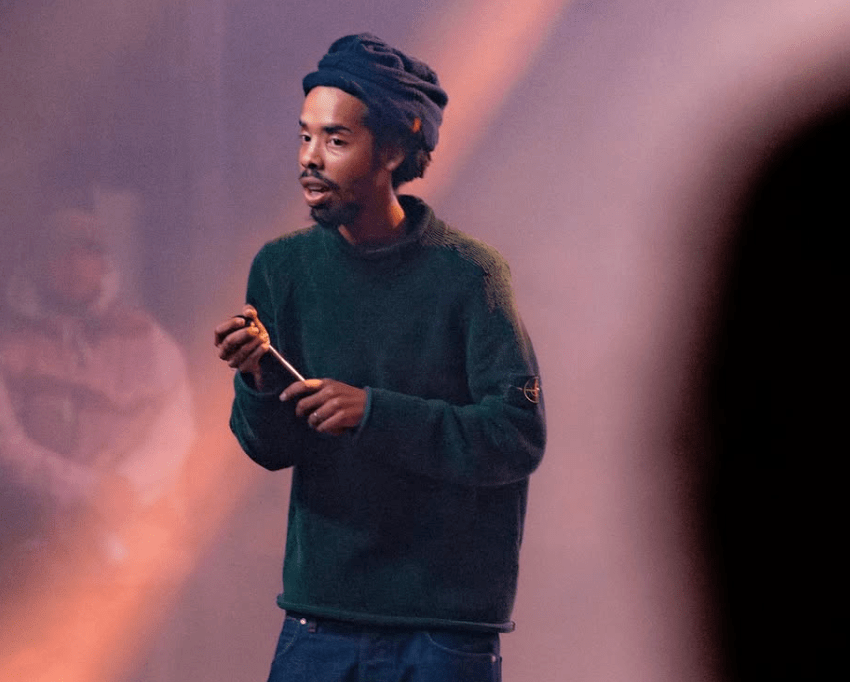
I could say endless things about Earl’s effect on the trajectory of modern rap music, but being in the crowd, in what felt like a community he stitched together from scratch, I could feel his impact deep in my soul. Joined by the zany & energetic Zelooperz, and my favorite modern R&B singer, the talented Liv.e, Earl stayed rooted on stage from the first opening track, hyping up his friends in a way I’ve never seen a main act do at his own show. God, that shit was cool. To see hip-hops favorite unc-turned-father-figure so joyously engaging in the community he cultivated was really a testament to how far he’s come. Not just as an artist, by the way, but as the glue for the contemporary hip-hop landscape. I’ve found pretty much all my favorite young artists as a result of Earl helping put people on. He’s introduced me to MIKE, MAVI, Armand Hammer, Liv.e, and so many other thoughtful, young, revolutionary creators and thinkers. His presence on that stage through the opening acts just cemented for me that his social web is no coincidence; he really cares for these people, and wants the world to experience their art. That’s priceless in an artist. The ability to create and evolve through one’s own work is hard enough, but to help an entire wave of younger artists get their footing is a giant feat.
His efforts were not misplaced in finding great openers either. Zelooperz had the crowd as involved as physically possible from the jump, and had me chanting “Fuck Cigarettes!” with a spliff in hand. It was an electric performance, and I got to see his breakneck mid-verse vocal-switch from low to high in person, which is probably one of the most impressive things I’ve seen a rapper do on stage. Liv.e followed up his incredibly hype set with a totally different vibe, but it was the perfect transition, as she glided through a set of upbeat electronic instrumentals and beautiful, engaged singing and chatting. At one point, she brought tears to my eyes with her tribute to “Brown Sugar” by the late and most great D’Angelo. That was special, and made me realize how important it is to see the artists live, where they have the freedom to pay homage to those they love. After playing an unreleased track from her new duo with Karriem Riggins “GENA”, it was time for the main act, and he had already been on stage the whole time, waiting and hyping up his people as the night went along.
It was really heartwarming getting to see Earl in person for the first time. He seemed to be so proud of his friends, and so happy to be performing not just his new work, but his old and unreleased songs. I don’t think I could have prepared myself properly for his setlist; it jumped across all his different eras seamlessly, allowing me to take my own internal trip, retreading where I was during each stop in his discography.
I thought before the show that he’d be more eager to show off his newer work exclusively, giving his longtime fans a glimpse into the man he’s become, but what I began to understand as he transitioned smoothly between songs was that the man Earl Sweatshirt is now has only made it this far because of his ability to work through the pain and anger he so effectively expressed in his older projects. It seemed to me that he could now sit with the discomfort of these old songs, and appreciate them as moments in time that have aided to his growth as an artist and man.
For the age group of all of us twenty-somethings who went from depressed chronically online music fans to empathetic people making art in the real world, Earl’s music does as good job reflecting our upwards trajectory climbing out of the depths of our lives and be better off. We’re all working on it. We’re not perfect, we’re young, and we’re still confused as hell. The thing the Live Laugh Love tour showed me, though, was that there’s no problem in any of that. Earl shows us a way forward with every bar, offering a path past suffering, towards something fruitful, that makes the pain so worth it.
 SoundFynd