
Analog Dreams, Digital Guts: Twee With Teeth
By Sydney Wills
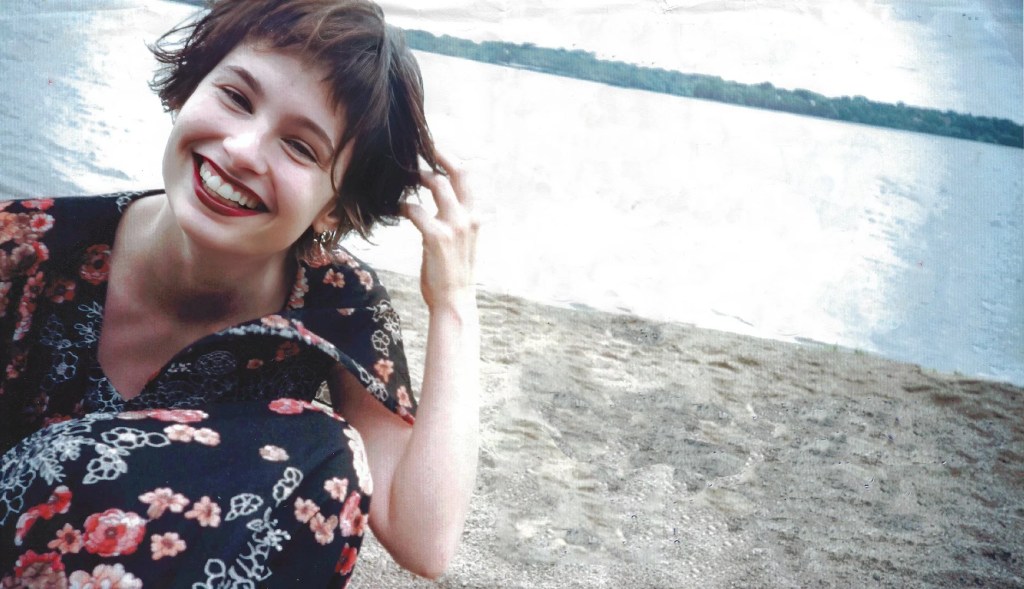
With her musical alias, Kitty Craft, Pamela Valfer builds her artistic sensibilities around independence and resilience.
In December, I had the pleasure of (virtually) sitting down with Valfer to discuss this independence, her process, and her “default twee-ness,” among many other things. Mere moments into our conversation, like a sacred omen, an elusive tail whipped across the corner of the screen. It was soon revealed — fittingly — to be her cat, Frodo, settling in nearby to observe as we spoke about her early influences.
“People often ask me, ‘What’s Kitty Craft like?’ and I tell them to imagine A Tribe Called Quest record with vocals by Simon and Garfunkel,” she said with a laugh. Valfer explained the affinity she developed for ‘70s harmonies as a kid, sharing an anecdote about her parents once leaving her behind to attend a Simon and Garfunkel concert despite her adolescent pleas. “You’ll get high just being there!” they told her.
Although that likely isn’t the first parallel that comes to mind when one hears the twinkling indietronica confection that is Kitty Craft, it is certainly fitting that her sense of vocals developed this way. Similar to the ensemble folk harmonies she was raised on, Valfer’s own vocals are a dreamy, haunting current that runs gently beneath her beds of instrumentation. Like a sun-drenched, twee ghost, her voice hovers with a melodic mellowness that would suit any track on Bookends.
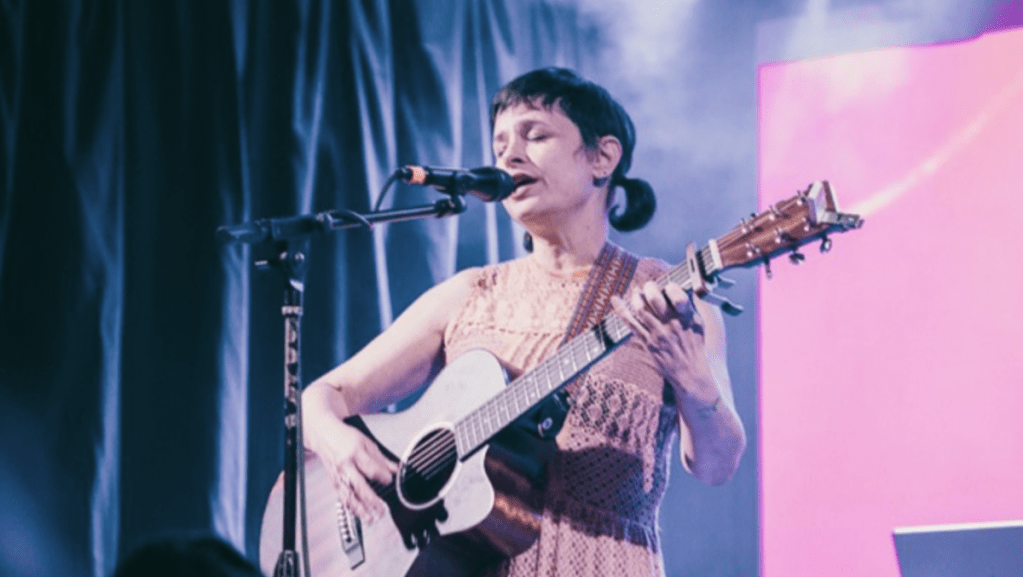
What truly distinguishes her music, then, is her ability to combine this with hip-hop rhythms. She described her discovery of more melodic and jazz-based rap in the late ‘80s, citing Tribe’s Low End Theory and De La Soul. “Those were just some of the little things that created pathways in my brain,” she said, explaining that she was inspired not only by the production and sampling of these musicians, but also the simple fact that they melded genres in such innovative ways.
And Kitty Craft certainly does meld genres. In addition to these choppy hip-hop beats and dreamy vocals, listeners are treated to a looped smattering of ghostly synths, clever sampling, and healthy doses of fuzz and warble. The result is a sound that feels both carefully constructed and gently destabilized, held together by repetition as much as by melody.
Much of this sensibility emerged through her earliest experiments with looping technology. Valfer explained that the first “loop-like” thing she ever played with was, of course, her 4-track. She cited Lou Barlow’s 4-track work with Sentridoh as a major influence on her early music-making. “I played with record skips, then began chopping up drums and looping them,” she stated, “this led to guitar songs where I’d occasionally sample instrumentation like a flute, or something.” On the recently reissued The Toytown Tape, she revealed that the drums were played on a phone book.
The technology behind much of Kitty Craft’s early work was minimal — its DIY spirit and the constraints that came along with it became a generative force rather than a limitation. Yet, Kitty Craft was hungry for innovation. “I always started out on the ground floor and improved with each record,” she said, explaining that she eventually sold her guitar to purchase a proper reel-to-reel 8-track. This is what she used to make 1998’s Beats and Breaks From the Flower Patch, her delicately psychedelic, breakout release.
In addition to the 8-track, she used a Dr. Sample and a Gemini 8-bit pedal to achieve the lo-fi fuzz so commonly associated with her sound. Valfer explained that she eventually purchased a keyboard with an inboard sampler that she was able to multitrack with for her 2000 LP Catskills. Valfer moved on to Pro Tools for the tracks archived in Lost Tapes, her 2020 comeback record that followed a two decade hiatus.
It is clear, despite her independence as an artist, that Kitty Craft consistently found ways to evolve alongside the digital production technology developing in the ‘90s and 2000s. “But ironically,” she lamented, “I eventually ended up feeling nostalgic for that sort of crackly lo-fi on Beats and Breaks.” This nostalgia led her to eventually pick up the Dr. Sample again after a period of experimentation using DAWs.
“Now, I play around in Audition, which is the closest thing to what Pro Tools used to do for me,” she explained. Despite these continuously bold plunges into technological advancements, Valfer expressed the difficulties that can come with having to relearn certain things after stepping away from music for a while. Fortunately, she has never been afraid of adaptation.
Her strong will and ability to figure out how to complete difficult projects are qualities that Valfer displayed repeatedly throughout our conversation. “I will totally learn and do whatever I have to do in order to execute an idea,” she shared, explaining that adapting to different modes of production and instruments is necessary to get things done as an independent artist with minimal resources.
When asked about whether her independence plays a role in her artistic innovation, she shared a common yet genuine sentiment: “If you want something done right, do it yourself.” Kitty Craft attributes this ethos partially to her double Virgo astrological placements, and partially to the desire to have her voice ring clearly within her art.
“I feel like in a lot of people, there is a sense of failure that can be very limiting creatively. You’re kind of done for if you have a fear of failure, because then you’re only gonna stay in your lane and not try anything new. If you can embrace the unknown and trust yourself to figure it out — that’s the big thing, we just don’t trust ourselves to figure things out. And that’s very limiting and paralyzing,” she said.
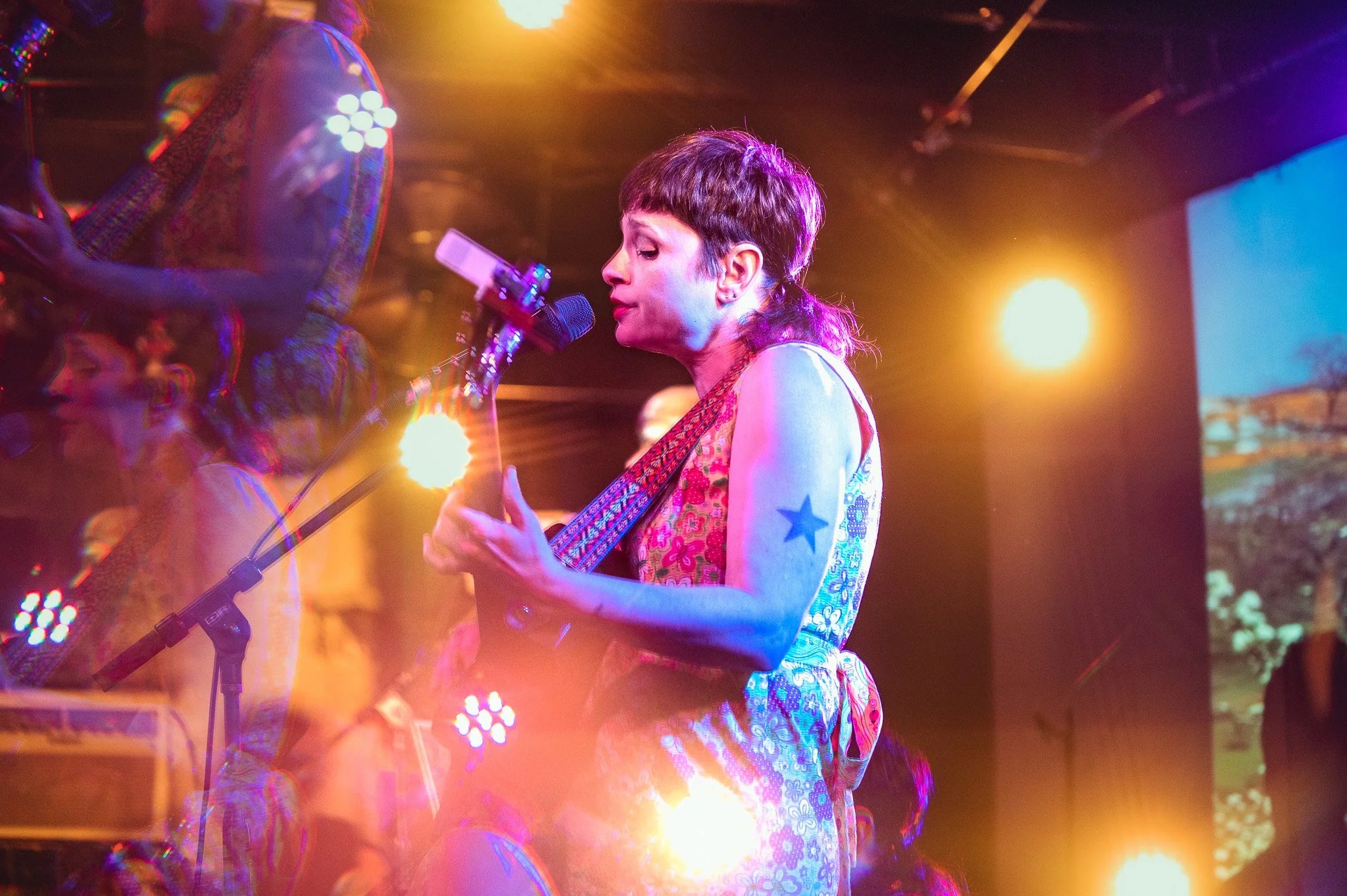
On the topic of corporate record labels, she reiterated the importance of “figuring stuff out” as a young artist, a sentiment which was particularly important to her identity as a female artist during a time when not many women were venturing into the world of production. Emphasizing the importance of curiosity, she said, “Back when I was doing music stuff, you didn’t have any sort of social networking — you’d literally have to put [flyers] on telephone poles if you were gonna play a show. Therefore, you were more reliant on someone who had the time, space, and contacts to help you out, which is why labels had so much power.”
Valfer has experience with small labels such as Kindercore and Takotsubo. She expressed her gratitude for them, but acknowledged that the “label mentality” is a system that bummed her out and partially caused her to step away from music for two decades after the release of Catskills. “Maybe I’m just a control freak,” she sighed.
Despite this, she feels hope for the future of independent music and expressed a pleasant surprise toward how easy it is for artists to do things on their own now. “The power has kind of shifted,” she explained excitedly, “You can really do it all yourself. It’s been a wonderful, eye-opening experience to step back into music and discover that it’s such a community.”
“If there’s less people in the kitchen, your vision can really shine through without any naysayers. Right now is the most flourishing independent opportunity,” Valfer told me.
The fearless self-reliance and desire to experiment are not exclusive to the music of Kitty Craft. In fact, her music-making began as a supplement to her visual art. “By experimenting with sound in my pieces, I was doing music in a back door way,” she explained.
Valfer received an MA in painting and currently teaches 2D art to students at a college in Los Angeles. She frequents both the LA and Berlin art scenes, and mentioned some conceptual art performances she’s done over the years: one of which involved a green screen tattoo and a television debut on “Wheel of Fortune.” Her art has consistently revolved around learning new things and adapting to new media — and her most recent venture is animation.
“Visual art and music were always like my two children who I could never love at the same time,” she said. “Only later in life have I learned to hold these two things at the same time.”
This prompted me to inquire about the immense uptick in popularity on the internet around her work, particularly Beats and Breaks.
Immediately beaming, she replied, “I am humbled and absolutely gobsmacked. I still kind of don’t believe it. It’s very humbling and I’m incredibly appreciative. Even though a lot of the people who love Kitty Craft weren’t even a sparkle in their mama’s eye while it was happening, I think there is something very comforting about it.”
After discussing her combination of old and new influences, as well as her perpetual drive to innovate, it is evident why the music of Kitty Craft has remained so timeless. When asked for her perspective on the reasoning behind the reemergence, Valfer said, “I think people are drawn to its sort of unquantifiable vintage sound. It reminds you of an early time, that analog sound, it reminds you of something warm and comforting. It’s both digital and analog.”
She is correct: there is an ephemeral nostalgic point at the center of Kitty Craft that all else pivots around. The classic folk harmonies, fuzzy production, and blissful atmosphere call back to a time of peace, like music meant to be played on a vintage radio that sits in a patch of sunlight on the windowsill. And yet the innovative sampling, chopped drums, and genre fusion keeps it modern, with an eye pointed steadily toward the future. It’s a recipe for timelessness.
But the aesthetic exploration continues. One thing Valfer looks forward to is doing more live experimentation with music, she expressed the hope that her first show back can be at her father’s retirement home, joking, “He needs some street cred.”
Beyond that, Valfer is working on converting her songs to acoustic guitar. Although she has no plans to record and release these versions any time soon, she said. In addition to guitar, she finds herself listening to jazz, particularly Ethiopian jazz as well as classics like Alice Coltraine and Bill Evans. At one point she expressed her love for soundscapes, saying, “I don’t want to think. I want to think about things I want to think about. I want relaxation.”
Relaxation for Valfer now looks like enjoying her life as an artist in Los Angeles. “The concept of place has less of an influence on my life now than it ever has,” she shared, “I’m in my own cloistered world, I feel more internal than external at the moment. I feel like I finally have the guts to not worry about ascribing to a certain thing externally. It’s a very empowering place, and it’s quite wonderful.”
“Because of all that, I’m probably more punk rock now than I ever was — I really don’t give a shit,” she said with a laugh. “And that’s what you have to look forward to later in life!”
 SoundFynd