
Dweller and the Sacred Social Worlds Corporate EDM Left Behind
By: Sydney Wills
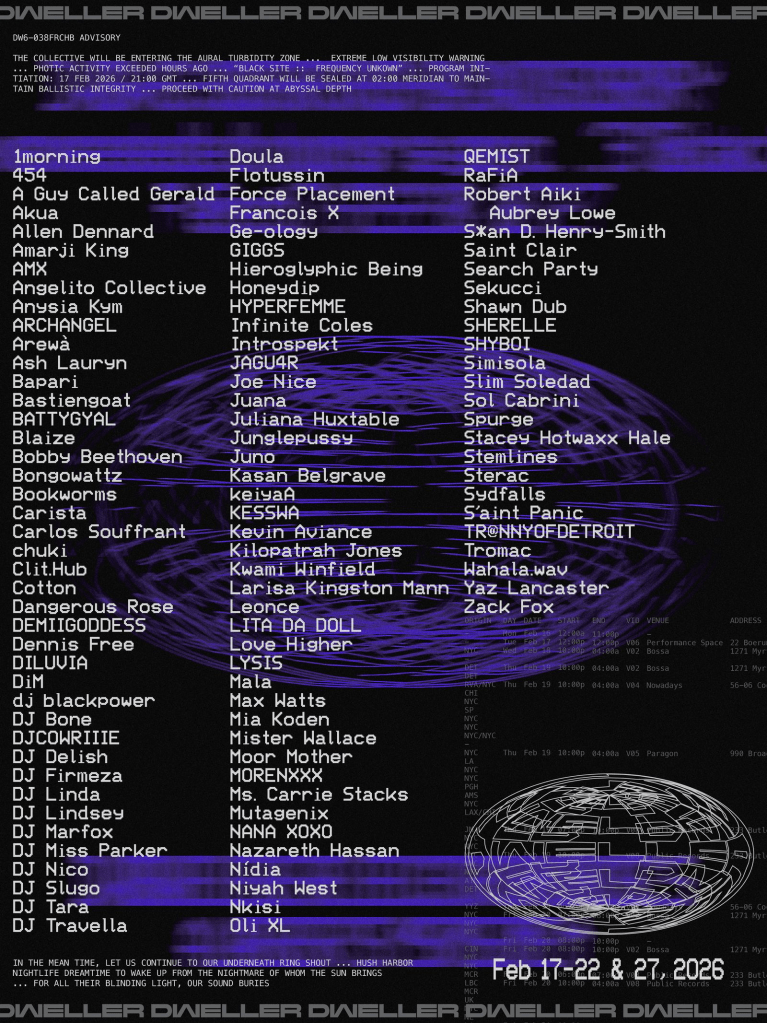
In case you missed it from beneath your rock, Dweller was back in NYC this past month. The independently-funded electronic music festival spanned multiple genres, nights, and venues across the city from Feb. 17-27. Though the event returned for the sixth edition since its founding in 2019, their mission has remained steady: to highlight Black electronic artists and platform Black perspectives.
The work that Dweller does across disciplines encapsulates this ethos well. In 2024, they secured a collaboration with Criterion Collection in which they curated a collection of Black films, many of which revolve around underground sounds. The anthology included filmmakers such as Phil Collins and Joseli Ramos, as well as a collection of shorts. The “Dweller Library” has also consistently provided open-access reading lists of postcolonial and anti imperialism literature, highlighting critics such as Kwame Nkrumah.
And what better time than Black History Month to celebrate a genre so historically whitewashed, commercialized, and institutionally gatekept from the communities that gave rise to it. As electronic music was embraced and adopted rapidly throughout Europe in the ‘90s, the genre’s queer and Black origins were obscured — a historical dispossession made worse by the corporate EDM explosion of the 2000s that culminated into a whitewashed festival era.
The result? A rapid expansion of multinational promoters and events like EDC and Ultra that tended to reframe electronic music as a mass spectacle rather than a localized cultural practice. These festivals consolidated enormous audiences around a narrow roster of globally marketable DJs, overwhelmingly white and European, whose visibility was amplified through branding and sponsorship. What had emerged in Chicago basements and Detroit warehouses as collective, participatory forms of sonic worldmaking, was recoded as a form of corporate entertainment.
It is precisely in response to this historical erasure that festivals such as Dweller become so critical. Dweller intervenes directly into this process of erasure by making visible the communities whose creative labor produced the genre in the first place, re-embedding the music within the social worlds from which it emerged.
Opening Night kicked things off on Tuesday, Feb. 17, at Performance Space New York with sets from Abdu Ali, SCRAAATCH, Sweater On Polo, Telfar, and Alexander G. Weheliye. The next day saw a two-night performance from DJ Miss Parker at Bossa in Brooklyn.
Thursday is where things got sticky, as multiple shows occurred across multiple venues within hours of each other, some even at the same time. For each and every festivalgoer, difficult decisions had to be made. Nowadays at 8 pm featured ARCHANGEL and keiyaA among others, while an hour later Moor Mother played b2b Hieroglyphic Being at Paragon as Limited Network, Bookworms, and DJ Linda played Public Records simultaneously.
Other highlights include Saturday’s 10K Projects packed show at Pioneer Works starring Anysia Kym, dj blackpower, 454, GIGGS, and Junglepussy. For a full list of events, see their website, which reads like a classified transmission or emergency systems log. The site is stunningly developed by Bryant Wells with a data-centric, anti-consumer interface design. It’s full of hacker/encryption aesthetics that the polished agents of corporate EDM branding would gawk at.
The show I had the pleasure of attending was Friday night’s Philly and Memphis-lead lineup at Paragon in Brooklyn. Upstairs, Honey Dip opened, followed by Zack Fox, with self-described “Philly jawn” and ballroom scenestress DJ Delish as the closer. DJ Nico and QEMIST went b2b downstairs all night. Upon entering the club, the Booty Bass-inflected atmosphere set by these latter two and their blend of Jersey bounce, jungle, and juke had an energy so palpable that it had to be my first stop.
So I ventured down to the basement, where a sweat-slicked crowd and minimum-of-145-bpm set greeted me after a precarious descent down narrow stairs. I felt myself brushed by velvety faux mink, rough shearling, and insulated wool while attempting to get in line for coat check. It seemed like everyone was beelining for the shadowy cloakroom so that they could shed the functional armor of the freezing outdoors and move uninhibited.
It was infectious. The Detroiter spectres of DJ Assault and Disco D seemed to materialize through the music and beckoned me to the dance floor. The room was so dense with fog and smoke that it wouldn’t have been hard to believe these ghettotech giants were really there, hovering proudly over the frenetic crowd as they pulsed to the genre’s iconically syncopated synth stabs. A member of my group remarked that it looked as if a Dark Souls boss was lurking behind the opaque haze.
DJ Nico and QEMIST served everything you could want from a heavy club set: hyper drum pockets, hilariously brash vocal samples chopped up into the mix, and an unrestrained energy that all of this evoked in the crowd. Few things can get a crowd moving like Ayesha Erotica’s electropop smash “spread that puss,” particularly when the iconic lyrics “Ciara, bitch, you can keep your goodies / I’m in the club just spreadin’ my pussy” are looped around ballroom kicks.
These two really used the more confined, intimate basement space to their advantage. Their heavy set was punctuated flawlessly with club tracks that got people dancing in a way that would put any discourse about a generational lack thereof in clubs to shame.
Eventually, we resurfaced. The narrow stairwell that had delivered us into the basement now carried us back upward as Zack Fox began his set. If you’ve never been to Paragon, the DJ on the main floor performs from a sort of clear glass box that looms mythically above the crowd. It’s a bit of a display, this Wizard of Oz-like presence orchestrating from behind the transparent barrier.
And orchestrate he did: the set began on the frenetic end, starting with a glitchy mix of experimental hip hop artist Psychoegyptian and RICK RAB’s track “SMASH IT UP.” The night’s trend of highlighting ghettotech continued with Chicago’s DJ Funk and his track “Digital House.” Later into the set, we were treated to house mixes of classic RnB tracks, such as Renee Winston’s uniquely high-energy praise song “Only God Can Do It.”
Everyone enjoyed the set from below as Zack Fox bumped nonstop in his white button-down shirt, encased in the floating booth like some sort of artifact in a glass reliquary. As the night stretched on towards 4 am and I began the long commute home on trains spotted with other festival-goers, it became increasingly clear that what Dweller had constructed across its ten-day sprawl was not merely a festival, but a network of temporary sanctuaries.
In the book Cruising Utopia, José Muñoz famously theorized the liminal space of the nightclub as a site of queer worldmaking, where marginalized communities can gather to produce forms of collective presence that exceed the social constraints imposed upon them outside its walls. It is not simply a place of escape, but a space of rehearsal, a space in which participants briefly inhabit alternative ways of being together. These experiences are ephemeral, made of gestures, sound, sweat, and proximity, but this embodied nature is just what allows them to function as glimpses of a social world otherwise deferred.
That this culture was later extracted, sanitized, and repackaged within corporate EDM festival infrastructures only underscores the importance of spaces like Dweller; the series restores its relational core, recentering the communities whose creative labor made these sonic worlds possible. Through this structural recentering of Black artists and audiences, Dweller reasserts the dance floor as a sacred space in the sense Muñoz describes.
To dwell, after all, is not simply to occupy space, but to inhabit it — to produce meaning, relation, and continuity within it. For those who gathered for any number of the festival’s shows across the course of the week, Dweller offered precisely this: a sanctuary where electronic music resumed its original function as a special social practice as a technology of collective becoming. Something lived, felt, and made real across the city’s dance floors.

If you would like to support Dweller and the people behind it, you may make a contribution via Paypal by emailing info@dwellerforever.blog.
 SoundFynd