

Charli XCX wanted The Moment to kill Brat. Didn’t she know it’s already dead?
By Niku Radan
[SPOILERS FOR 2026’s THE MOMENT BELOW.]
I’ve felt a lifelong kinship to gay men that’s seemingly only ever been matched by four people: Madonna, Cher, my mother, and Charli XCX.
I came of age in a cultural space adjacent to Charli’s, white-knighting for Marina and the Diamonds in Tumblr stan fights1, crying teenage tears of joy when drag queens looked my way, and flipping between identifying as bisexual and pansexual based on which flag I liked better that week.
Despite this, it took me til 2022 to become a certified Angel2.
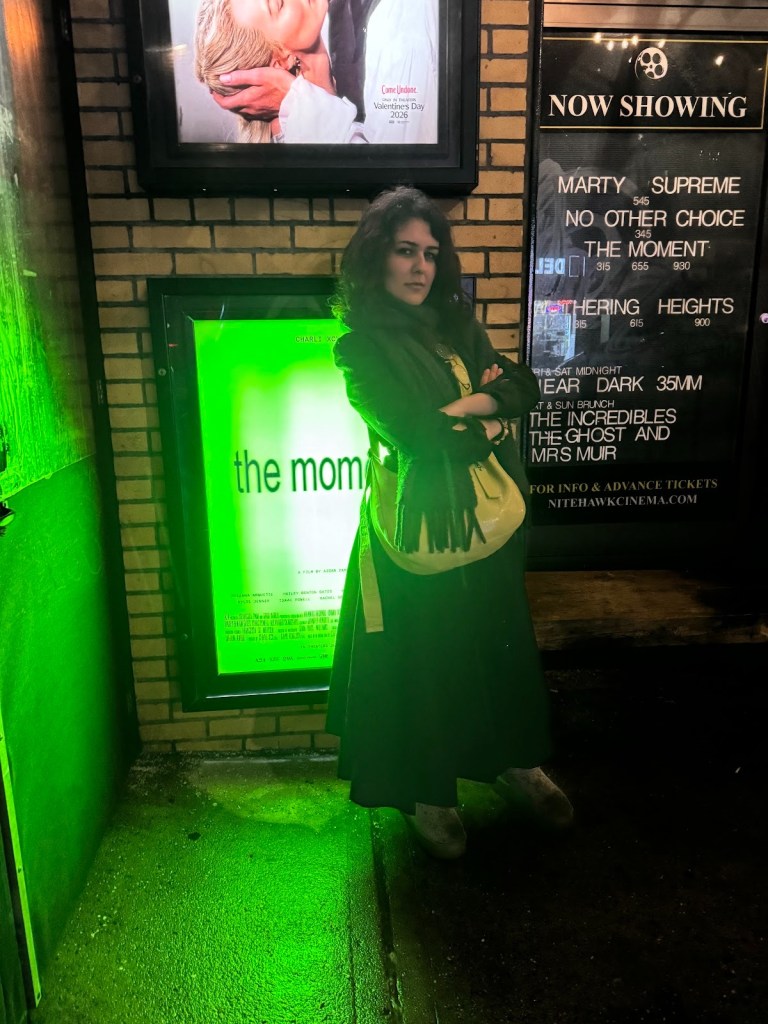
Me clocking into work at the Angel factory hahaha… actually I want everyone to know I did NOT watch Wuthering Heights.
I lay this groundwork to make clear that, when Brat launched Charli XCX into the mainstream, I felt nothing more than mild relief — the world had finally caught up to a party I thought even I was late to. I also lay this groundwork to make clear that my disappointment in The Moment has nothing to do with any personal fandom.
The Moment presents us with an alternate Sweat Tour, one where Charli tries to balance her and her team’s artistic vision with that of her label and an outsider — a documentary team led by Alexander Skarsgård’s insufferable Johannes Godwin — before ultimately assimilating herself into a creative persona she’s said to have spent the film fighting. It’s a great idea, contemporary assimilation narratives are typically found in sci-fi/fantasy tales and seeing one used to communicate the suffocation of pop stardom sounds compelling, but its execution is poorly thought out.
Most of the issues within The Moment spawn from an unintentional void left in Charli (the character). Charli is a problem in this film in three ways, the first being that her motivations change by the second. To give you an idea, here’s a list of her notable actions in chronological order:
- Charli starts The Moment laughing with her creative director, Celeste, about how she needs to kill Brat in order to move on.
- When other characters take any action which would kill Brat, Charli tries to protect its sanctity.
- She gets overwhelmed and flies to Ibiza to avoid everyone.
- She decides to give Brat up to Johannes because Kylie Jenner told her that he’s a big deal — sidenote, I like Kylie Jenner, but does she have the cultural cachet for her recommendation to act as the movie’s turning point?
Charli promptly abandons her creative director and longtime friend, Celeste, for Johannes’ vision, only to break down and go into hiding over the pressure she largely put on herself. Throughout The Moment, Charli is often able to give her input on how her Brat promotion is going and refuses to do so, usually choosing to yell at her manager, Tim3, instead. She then ends the film admitting this was what she wanted all along, that she did everything she did in order to kill Brat.
Brat gained its popularity in part thanks to its multifaceted depiction of Charli’s life at the time of recording: it’s an album that packs the consideration of motherhood, a coke habit, and an undying love for Dasha Nekrasova into 41 minutes and 23 seconds. One may argue that the erratic behavior displayed in The Moment is in line with the messaging of the album, but there is a difference between being a multifaceted person and not being much of a person at all. The character of Charli is the latter, existing to further the plot by possessing no will of her own.
Thanks to this plot-driven focus, I found myself regularly forgetting that The Moment was supposed to be a comedy. Jokes are stated as fact and rushed past in service of making the plot make sense.
The jokes are not there to make you laugh, they’re there to take you from point A to point B. For example, Charli has a “gay credit card” (a lime green Brat card, aimed at a gay audience) which she has to promote. She inaccurately advertises the gay credit card, causing a gay credit card-induced bankruptcy. This takes such a toll on Charli (who has not cared about the credit card for the entire duration of this film) that she disappears and calls Celeste to tell her, and the audience, the thesis of the film: that Brat is a party from which she never wants to go home, but that now she needs to kill it. This is an issue because it pulls back the curtain and allows us to see the writers — jokes are never given the room to breathe4, so as viewers, instead of laughing, we wonder what new plot point we’re being spoonfed next.
Additionally, there was no reason for The Moment to be a mockumentary. The mockumentary format doesn’t lend itself to the humor or plot of the film, unlike successful takes on the genre like “This Is Spinal Tap.” In a traditional narrative comedy scene, we watch people live their day-to-day lives and find comedy incidentally. In a mockumentary, your characters can still do this, but also have a chance to specifically dictate their image to the world at large — only they’re screwing it up. That’s what makes it funny. The real advantage of a mockumentary is its fourth wall breaks, which are a helpful cheat for quickly feeding exposition to the audience, while making jokes that land more immediately due to the direct address. But they’re few and far between here — most of them, Rachel Sennott’s cameo being the primary exception, tell us nothing about the character who is breaking that wall or the story itself.
What’s also difficult about The Moment is that Charli seems to have collaborated on it in order to kill Brat, but it was released a year and a half after Brat and six months after the final Sweat Tour date. Brat summer was already over, and another summer had after had already passed. This film, in effect, only killed pre-Brat Charli by making her career solely about Brat.
Charli XCX’s career as a former “Khia Asylum detainee5” was funny. She used to have to hold poppers at her record signings and shout “gay rights” at phone cameras — mentioned in passing in The Moment. She had to come out as straight and lament her lack of bisexuality. She went on a Chinese singing show, had her in-ear translator fail, and had to pretend to understand Mandarin during her aired segments. She once reposted a leak of the lyrics to her own song “claws,” was bullied over their perceived lack of quality, and then received apologies after releasing the song because she somehow made the lyrics work. Her biggest songs for ten years were “Boom Clap” and “Fancy.”
Pre-Brat Charli was an undeniably innovative artist, having to put in years of publicly degrading work because she hadn’t yet made anything that clicked with mainstream audiences. This is not addressed in The Moment and pre-Brat Charli’s struggles are instead grafted onto Charli’s post-Brat life. This is confusing — The Moment both expects you to know Charli’s history but suspend your disbelief for long enough to watch an entire film about her that doesn’t incorporate it. It expects you to project a lack of creative control onto her real-life peak and expects you to ignore the fact that we all saw her struggle more with this prior to Brat.
There is a way for Charli to center her current project without dropping her past: she herself proved this in 2021 with Alone Together, an actual documentary following the collaborative production of her album how i’m feeling now. This was a documentary that saw Charli collaborating with fans while keeping her album on a strict time limit of six weeks to go from writing to release — like Brat, it was a unique moment for her career. The film’s not a masterpiece by any means, and it doesn’t take nearly as big of a swing as The Moment does, but it’s able to center the unique moment of how i’m feeling now while also acknowledging who Charli’s been, what she wants, and how she may struggle in achieving it.
The Moment wants to talk about Brat’s rollout as a battle between capitalist interests and artistic expression without directly addressing that as the central conflict. Each scene is introduced with flashing title cards, often depicting brand logos, indicating to us that every move Charli makes in this film has a shareholder guiding it. Charli’s label, personified by Rosanna Arquette’s Tammy, pushes for Charli to enter unsuitable partnerships in order to maximize Brat’s profits — one such example being the fictional Howard Stirling Bank’s “Brat card”, which proves disastrous. Tammy also “strongarms6” Charli into producing a concert film directed by Johannes, a director whose work is described as objectifying. Johannes then spends the film making changes to Brat’s subject matter, visual style, and even its album cover, all to make the tour, and concert film, more “family friendly” — a trend real executives have increasingly pushed onto what would’ve previously been age-delineated media in order to increase profits via “co-viewing.”
This film brings to mind — hopefully not just for me — Succession, primarily
in its visual style and dialogue-driven English humor7, but also in its depiction of capital interests as inescapable inevitable forces, ones which are tragically wholly stoppable from an audience perspective.
Kendall, Roman, and Shiv turn against one another for a chance at inheriting a failing media conglomerate that’s ultimately a substitute for their father’s love. Charli XCX bankrupts a financial company because she doesn’t want to let her moment go.
However, despite its heavy-handed allusions to capital as a motivator, The Moment never pins it as an actual culprit, instead leaving the blame for Brat’s corruption at Charli’s feet in a monologue towards the end of the film where she laments the end of a party (or a moment), talking about how she never wants to go home. Charli’s moment, according to the character, was not artificially extended to extract as much profit as possible (despite what we saw with our own eyes) — it was extended so Charli could finally let it go. Her final monologue doesn’t match her actions throughout the film, from the start she seems to very much want it gone.
Again, The Moment is an idea with legs. It has stunning visuals. It has a hilarious source material which it rarely farms. It could’ve been a good movie had it clarified Charli’s character, divorced itself from Brat — which we’d already attribute it to, due to its subject matter and Charli’s involvement — and come out a few years later. The Moment wanted to tell a story about an artist assimilating themselves into the capitalist beast in order to finally move on to their next work, but it lost that story by never letting that artist put up a real fight.
- I most notably did over the “That FROOT looks familiar!” tiff, where Marina and Charli briefly butted heads because they happened to book the same photographer. ↩︎
- Charli XCX fans go by Angels. ↩︎
- Played by Jamie Demetriou, who wrote and starred in the very funny “Stath Lets Flats”. ↩︎
- Room to breathe in this case is the comedic principle of the straight man, that is, the character you are supposed to almost react with. The Moment wants that character to be Charli and only Charli, which is difficult due to Charli’s aforementioned lack of internal life. ↩︎
- Khia Asylum: A hypothetical prison or asylum where pop stars or rappers seen as past their prime, known as khias, are said to be locked up. Definition taken from Wiktionary. ↩︎
- In quotes because, as previously explained, Charli had multiple clearly delineated chances to change her fate. ↩︎
- “Succession”’s showrunner, Jesse Armstrong, is an English writer who also created and wrote for iconic UK sitcom “Peep Show”. The only other writers to define contemporary “British humor” include Armando Ianucci (In the Loop, The Thick of It, Death of Stalin), who went on to create Veep, and Graham Linehan (Black Books, IT Crowd, Father Ted), who ruined his own career and marriage over his obsession with tweeting about transgender people. ↩︎
 SoundFynd