
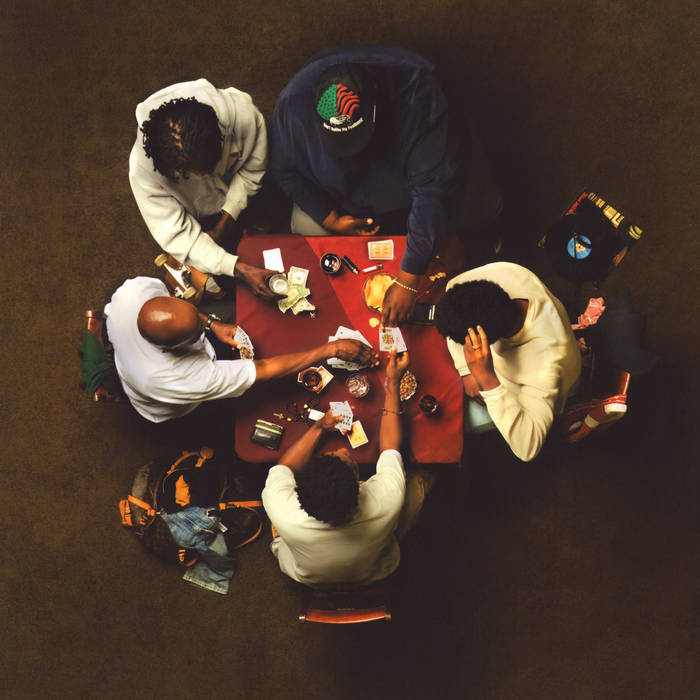
By June Hall
Chuck Strangers has spent most of his career carrying two reputations. To one audience, he’s the producer who helped soundtrack Pro Era’s emergence in the early 2010s, building dusty loops that felt inherited rather than manufactured. To another, he’s the rapper whose understated writing has gradually demanded equal attention. Glory of the King’s Hand is the first time those identities have felt completely inseparable.
It’s a deceptively simple statement for a record that spends nearly an hour blurring the distinction between beat tape craftsmanship and personal songwriting. Throughout our conversation, Chuck returns to the same idea repeatedly: this wasn’t about proving he could still produce. People already knew that. The challenge was proving his verses could command the same gravity.
He believes they finally do.
That confidence extends beyond the present moment. Chuck doesn’t simply describe Glory of the King’s Hand as his strongest album, he talks about it like a benchmark he’ll be chasing years from now. Five years down the line, after more records inevitably arrive, he hopes listeners still point back to this one as the defining statement.
“I want heads to come back like ‘He was really talking on this one.’”
Chuck Strangers says, less as a prediction than an expectation he set for himself while making it.
The title itself carries the same kind of layered confidence. Lifted from the Yu-Gi-Oh! card Glory of the King’s Hand, whose mythology awards its holder a fictional $3 million prize, the reference feels appropriately esoteric. It’s not a nostalgic wink so much as another metaphor for attaining something almost impossibly rare after years of persistence. Like many of the album’s strongest moments, the payoff belongs to listeners willing to look beyond the surface.

That philosophy also explains why “Solo” occupies such an unusual place within the tracklist. Chuck expects it to be overlooked initially. It’s not designed to announce itself on first listen; it’s meant to unfold slowly, rewarding repeated returns rather than immediate reaction. In an era increasingly dictated by first impressions and playlist placement, Glory of the King’s Hand often seems unconcerned with either.
The album’s most difficult song to finish wasn’t its quietest, though. “L2LL2C” fought him every step of the way.
Chuck usually writes before hearing production, allowing lyrics to exist independently before finding their musical home. Reversing that instinct required patience. What eventually became one of the album’s emotional centers was also the song that demanded the most rewriting, reshaping, and restraint.
Elsewhere, collaboration arrives almost accidentally. After finishing the writing and arrangement for “Breaking Atoms,” Chuck realized the record still felt incomplete. There was empty space lingering near the end. He played it for Mekala Session of Human Error Club, who immediately suggested bringing billy woods into the picture.
Even on an album populated by outside producers, Chuck never relinquished authorship. If anything, Glory of the King’s Hand became an exercise in learning how to delegate without surrendering vision. He intentionally resisted producing every track himself, not due to a lack of confidence in his own abilities, but rather he wanted to challenge the habits he’d developed over more than a decade.
Still, executive control never disappeared.
Every beat ultimately answered to the same aesthetic language, preserving the cohesion that’s long separated Chuck’s projects from loosely assembled producer showcases. The difference this time is that the conversations became broader without diluting the perspective at the center.
That evolution mirrors the way he talks about Pro Era.
When the collective first emerged, music happened because everyone happened to be together. Records were made in bedrooms and basements, born from proximity as much as inspiration. Growing older inevitably complicated that rhythm. Adult responsibilities scattered the group across different schedules, cities, and careers. Collaboration now happens through text messages, email threads, and phone calls instead of endless studio sessions.
Chuck doesn’t romanticize either version.
That’s simply what longevity looks like.
He says of those early years:
“I was just bullshitting with the homies.”
The phrase lands with affection rather than dismissal. Because if Glory of the King’s Hand is about anything, it’s recognizing that the carefree version of yourself never entirely disappears, it simply grows alongside new responsibilities. Chuck still writes from the perspective of his government name, refusing to hide behind an exaggerated persona. The man making these records today isn’t disconnected from the teenager who first started recording with his friends. He’s simply older, sharper, and considerably more self-aware.
Asked to compare the album to a film, Chuck reaches for the coming-of-age genre. Not the Hollywood version overflowing with melodrama or violence, but something quieter and more recognizable. The milestones aren’t spectacular. They’re gradual. You realize you’ve changed only after looking backward.
“Everyday” embodies that progression more clearly than any other song on the album. Chuck points to it as the record where his evolution as an emcee and producer becomes impossible to separate. The verses don’t exist to complement the beat, nor vice versa. Each strengthens the other until the distinction stops mattering altogether.
If there’s an unsung connective tissue holding Glory of the King’s Hand together, Chuck credits Obii Say. Across the album, no collaborator resonated with him more. Rather than sounding like guest appearances stitched into the tracklist, Obii Say’s contributions dissolve into the record’s larger architecture, helping sustain the immersive atmosphere Chuck envisioned from the outset.
Taken together, Glory of the King’s Hand feels less interested in reinvention than refinement. Chuck Strangers isn’t abandoning the producer who first earned widespread recognition, nor is he asking listeners to forget the rapper he’s steadily become. Instead, he’s collapsing the distance between the two.
For an artist whose career began almost accidentally, just another kid making music with friends, that synthesis may be the rarest prize of all.



Leave a Reply