
By Harry Sutton
Photos By Zoe Carlaftes, Carsten Nahum, and Grace Anthony
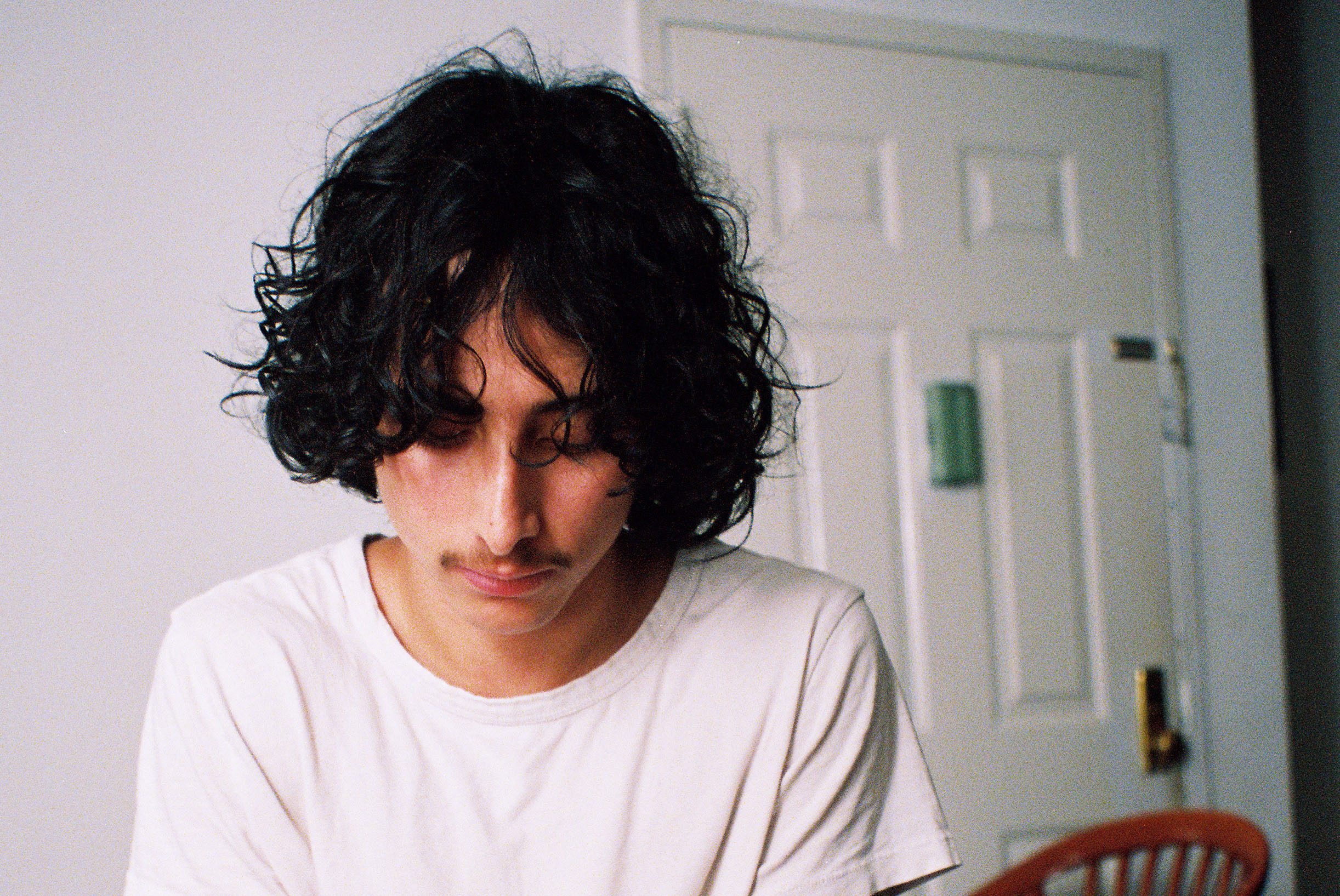
Superfan wasn’t always a band. It started as the solo project of Kali Priya Flanagan, a Los Angeles-raised songwriter, multi-instrumentalist, and producer who signed his first record deal at the age of 14, while making music as his eponymous indie pop project KALI.
When we sat down at Columbus Park in Chinatown last month to talk about Superfan’s new album, My Piledriver Heart, the first thing Kali told me about was the friendship he formed with his “now-bandmate,” cellist Omeed Almassi while they were recording his first album as Superfan, Tow Truck Jesus, a few years back.

“It felt like there was a shared language between us that I had not felt with anybody else before. I could give him the parts, but he executed without me having to say much. He just understood.”
Kali Priya Flanagan
My Piledriver Heart — out this Friday, October 16th via AD 93 — was written by Flanagan over two years ago, while he was recording Tow Truck Jesus. Although both albums were created around the same time, the sounds and textures of each record are entirely different. That’s largely due to the connections Kali has made over his time in New York’s scene, where he moved in 2023.
“I’ve always been somebody that is really closed off to collaboration up until I made Piledriver,” he said.
He had met Omeed at a birthday party in LA years earlier and they first formed their connection during Tow Truck Jesus, but the pair grew even closer while Kali was visiting home that next summer and they spent a week rearranging Superfan’s entire catalogue for cello. Suddenly, Superfan had become a band.
“It just felt like ‘Oh my god, we need to keep doing this,’ and he decided to take a one-way to New York. Since then we have spent most of our time together and he’s my best friend now,” Kali told me.
They spent the next few months arranging Piledriver every day across their two apartments, and ended up with a raw and earnest, ballad-driven chamber-rock record that unpacks the period of isolation, heartbreak, tumult, and discovery that Kali underwent while settling into life in New York.
That isolation, however, was familiar. Understanding My Piledriver Heart requires looking back at the machinery Kali had to break away from in order to create it. His trajectory in the music world isn’t one you see all the time — in fact, you’d be hard-pressed to find another 22-year-old with as much musical lore behind them.
An indie pop prodigy, he was self-taught in guitar, bass, drums, violin, upright bass, and production by his early teens. Releasing early music under his record deal as KALI, he quickly found himself stymied by LA studio sessions with high-profile producers and industry teams who would watch his every move in search of a new single to pitch to Spotify’s Lorem playlist.
He began to feel out of place in his home of LA, which he told me was “a place to go when you want to shut yourself off from the world.” As he was growing into an adult, he sought something deeper and rawer musically, felt socially suffocated by LA’s sprawling isolation, and struggled with identity.

“As a trans person, you have to fight against a lot of pressures and a lot of confusion and misunderstanding that’s projected on to you. I spent like 18 years of my life trying to figure out who I was, or suppressing an instinct that I had from a young age.”
Kali Priya Flanagan
While thankful for the privilege he had to be able to work in art from a young age in Los Angeles, Kali felt smothered in his own home city. Had he stayed in Los Angeles, Kali supposed he would have ended up “stagnant and bored and questioning what I was doing with my life.” It’s the insularity of Los Angeles that prevented Kali from becoming the artist and person he needed to be — an insularity that is just about impossible to maintain in the bedlam of New York.
“I feel like I wouldn’t have gotten the support that I have right now if I hadn’t been here. It just feels like the right context for music that’s more out there, and it always has been that place,” Kali said of the city, “New York is just inherently weird and full of strange coincidences.”
Soon after he began collaborating with Omeed, these strange coincidences seemed to come to Kali in spades. He started playing as a bassist for Brooklyn emo band Holidays in United States (who released one of the best records of the year, How To Count To Five earlier this month) and began to work on music with folktronica artist Operelly. Even outside of NY, Kali started to work more closely with his long-time friend from Los Angeles, singer-songwriter Jordan Patterson (who contributed vocals on the Piledriver track “We Were Listening To A Different Time.”)
While Piledriver couldn’t have been made without the tightly-knit creative ecosystem that Kali has found himself part of, the lyrics of the record look inward: processing the feelings of love, growing up, and the absurdity of life itself. This self-examination is reflected in the record’s sound too, rejecting the overproduced, glossy pop music of his teens, Kali didn’t want Piledriver to sound like it was made in a studio, but rather for the listener to feel like they’re present in the room, hearing him bare his heart out in the most deeply intimate of arrangements.
“Feeling like you’re hearing it without processing is really important to my music, because I feel that there are these trad ways of compressing and altering acoustic instruments in the indie rock genre that I think are really tasteless.”
It’s an atmospheric, ambient-leaning space where acoustic guitars, drums, and Omeed’s striking cello arrangements breathe completely on their own terms.
That unvarnished approach extended to his vocals:
“When I was making [Piledriver,] my voice was still changing, but it had started to settle,” Flanagan noted.
This physical evolution mirrored his artistic journey, creating a direct, intertwined progression where settling into his identity ran parallel to finding himself musically. Leaning into a striking androgyny inspired by vocalists like Cat Power and Rufus Wainwright, he and his producer even joked that he was doing a “Lana Del Rey impression” in the booth — balancing deep emotional gravity with a self-aware wink.
Tracks like “Jason Powers or The Underminer” and “Miss W Jones” were written about real people from Kali’s life — despite the record’s atmosphere bearing an almost movie score-esque grandeur, the stories are as genuine and unfiltered as they come.
One word that kept popping up during our conversation was “naturalism.” The record is packed with heavy, visceral imagery: the mechanical weight of industrial machinery colliding with the natural world, swaying trees, and raw, human elements like bodies, blood, and grief. This imagery is compounded by the record’s visuals, including the surreal montage visualizer Kali made for “Ode to Hum (I want it to rise)” and a live session his band played in the hulking, dark warehouse of the Agger Fish Building at Brooklyn Navy Yards.

Superfan’s early releases sound nothing like KALI, and the world he constructed on Piledriver sounds nothing like Superfan’s early releases. Kali’s artistic mind is one that is constantly evolving, synthesizing literary and sonic influences from Ryuichi Sakamoto to James Baldwin to Pedro Almodóvar. He described the creative process of working on newer music in New York as “breaking free from the shackles” of the point of his life where industry executives once lurked over his shoulder.
But these substantial shifts don’t mean that Kali abandoned his pop instincts entirely. Beneath the record’s noise, string arrangements, and experimental textures, Kali remains fundamentally drawn to creating melodies that lodge themselves in the listener’s head. “I’m always still drawn to pop music, pop melody, and the utilization of the voice, having a hard-hitting chorus,” he said. The album was produced by Hudson Pollock (Operelly, quinnie), whose previous work maintains a similar balance between pop appeal and storytelling sincerity.
On Piledriver, Kali reckoned with self-acceptance in the face of uncertainty, opened himself to collaboration, and created a textured, vulnerable world of his own. Still, as we sat on a Columbus Park bench, he hesitated to define the record as a destination.
“I don’t think that I will ever arrive, because I think that change is a constant.”
Kali Priya Flanagan
True to his word, he’s already started working on not one, but two albums to follow Piledriver. He’s a creative force who doesn’t seem to know how to stop — while he’s happy with what he’s built, he feels the need to continue, to articulate more feelings, and to keep pushing higher until he hits the ceiling.
Piledriver is the sound of an artist who’s made leaps and bounds. Both sonically and personally, it’s an evolution bolstered by Kali finding comfort in the unknown, learning to trust his instincts, and opening himself up to the friendships he’s forged in the creative mayhem of New York and carried with him from the coast he left behind.


Leave a Reply